


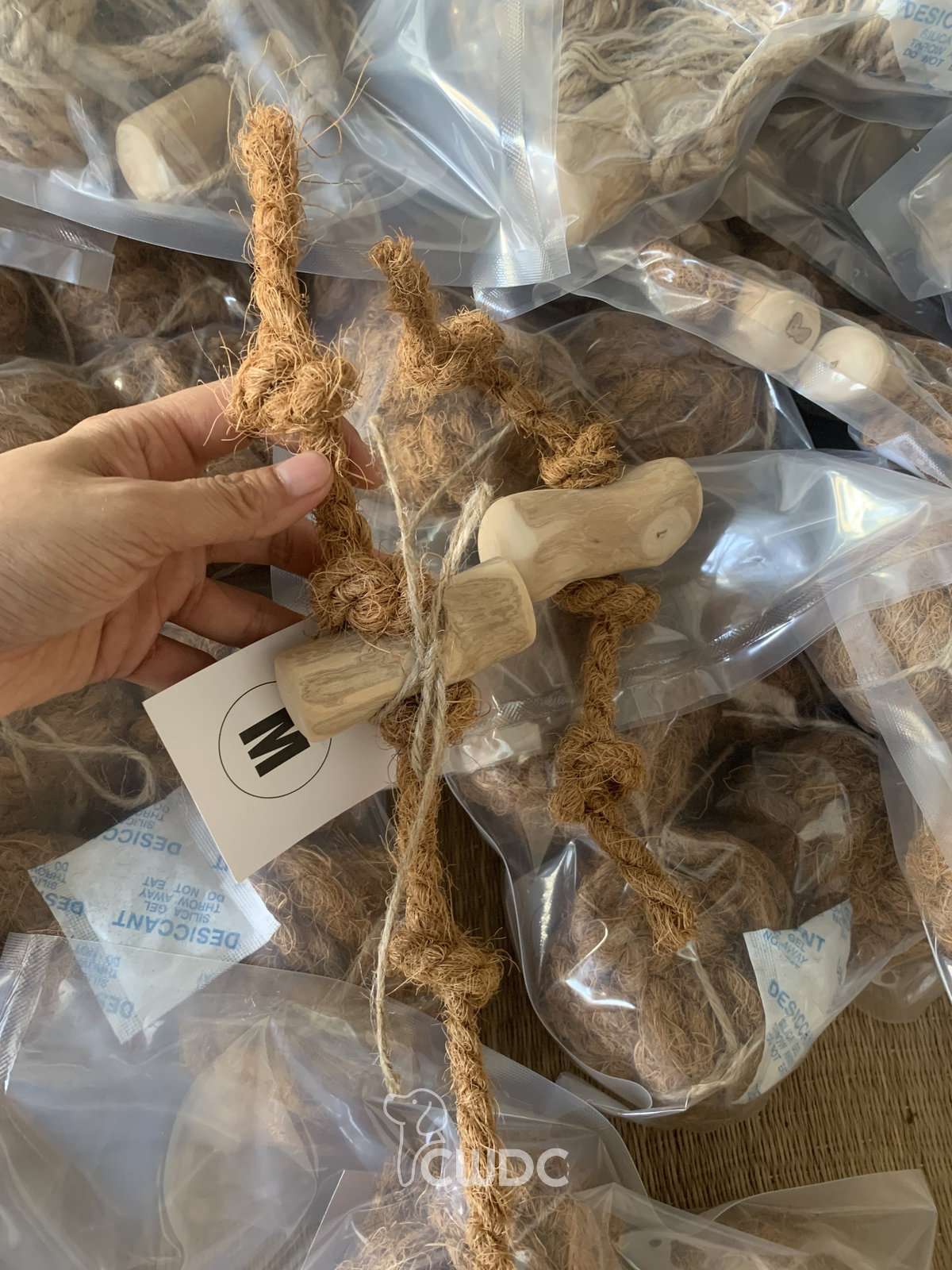
Coconut coir behaves differently from solid coffee wood once it leaves the factory floor. Fibrous material absorbs and holds moisture more readily than a dense branch section, and that difference shapes how CWDC Vietnam packages coconut coir dog toys for export.
This guide explains why every coconut coir dog toy leaves our facility individually vacuum-sealed, and what an importer should verify before a bulk order.
Why Coconut Coir Needs Different Moisture Control Than Solid Wood
A solid coffee wood chew can rely on carton-level protection during export, since the wood itself resists moisture fairly well once properly dried. Coconut coir fiber does not behave the same way.
Coir fiber is naturally absorbent, which is part of what makes it useful as a chew material. That same property makes it vulnerable to humidity during a multi-week ocean shipment.
Therefore, our packaging approach treats each coconut coir toy as an individual moisture-control unit, rather than relying on carton-level protection alone.
How Each Toy Is Individually Vacuum-Sealed Before Boxing

Every finished coconut coir toy goes into its own vacuum-sealed poly bag before it reaches a shipping carton. This removes excess air and limits how much ambient moisture can reach the coir fiber during transit.
Additionally, the small coffee wood toggle at the center of each toy is naturally air-dried before assembly, since it falls into our small-size product classification. Vacuum-sealing then protects that dried wood alongside the coir itself.
As a result, both materials in the same toy travel under the same moisture protection, rather than treating the wood and fiber components separately.
Why Every Bag Includes a Desiccant Packet and Size Label

Each sealed bag also contains a desiccant packet to absorb any residual humidity trapped during sealing. This adds a second layer of protection beyond the vacuum seal itself.
Furthermore, every bag carries a printed size label before it goes into a carton. This lets our team verify size accuracy at the unit level, not just at the carton level.
Consequently, an importer receiving a mixed-size bulk order can rely on the label inside each bag, rather than trusting carton markings alone.
What Happens When Moisture Control Is Skipped
Fibrous material that ships without individual sealing can absorb ambient humidity throughout a long transit route. By the time a container reaches its destination, the damage is already done.
Common outcomes include musty odor, fiber discoloration, and mold risk on the coir surface. Each of these turns into a rejected shipment or a costly reorder for the importer.
On the other hand, a supplier who seals and labels every unit individually catches this risk before the product ever leaves the factory.
Questions to Ask Before Your Next Bulk Order
First, ask whether coconut coir products are sealed individually or only protected at the carton level. Individual sealing signals a supplier who understands this material’s specific risk.
Second, ask whether desiccant packets are included inside each unit, not just inside the shipping carton as a whole.
Finally, confirm how size labeling works for mixed-size orders, since accurate unit-level labeling avoids sorting errors after the shipment arrives.
Sourcing Coconut Coir Dog Toys From CWDC Vietnam
CWDC Vietnam manufactures and packages coconut coir dog toys directly, from raw fiber processing through individual vacuum-sealing and size labeling. Every stage happens under one roof, which keeps packaging quality consistent across every production run.
For importers evaluating this category, explore our Coconut Coir Dog Toy line to review current specifications, read about our quality and sustainability commitments, and check our FAQs for common bulk order questions.


